Archive for the “Articles” Category
Few pieces offer a more personal snapshot of a given team at a precise moment in time than a signed team baseball.
Unless dated, old baseball photos can offer only a guess as to when they were taken. An autographed team ball, when all players are represented, can often be pinpointed to a specific month, week or sometimes even a day.
Stars, semi-stars, and common players are all represented equally. In fact, the autographs of many commons may be harder to come by individually than many stars. While the accomplishments of a team in a given season can be dubious like the 1988 Baltimore Orioles or glorious like a World Series champion Yankees signed ball, the ball autographed by a team represents those accomplishments equally.
Usually, the absence of a signature by a player can help define when a ball was signed due to the date of the transaction either by trade or free agency. Of course, the more stars or Hall of Famers on a ball will result in a greater value and a higher price.
Finding an authentic team signed baseball in great condition can be a bit of a challenge. Because of the nature of the item, if all team members attempt to sign the ball right after one another smudges and smears are likely. These defects not only affect the value of the ball, but may also make authentication nearly impossible.
Depending on the price of the ball in question, a buyer may seek to have a third party authentication service certify the team signed baseball prior to completing purchase. However, a higher valued ball, for example the 1927 Yankees, will likely already have the necessary documentation proving its authenticity. One guideline however, a certificate of authenticity is only as good as the company providing it. Collectors should recognize the name, and perform some research before spending a lot of cash. PSA/DNA, James Spence and others do a generally fine job with authentication.
Team signed baseballs are a great way to recall a World Series year, a record year for wins, or other team accomplishment. Because collectors have favorite teams and favorite players, this type of collectible benefits both desires. Sometimes just reading the names (though handwriting is sometimes questionable) can help a collector recall each individual player and the ups and downs of a baseball campaign.
The nostalgia can be somewhat overwhelming ten years down the road, as these great snapshots of history capture every player that was on the team at that specific moment. Signed team baseballs make for a terrific collecting focus, whether you’re collecting All-Star teams, World Series winners, specific teams or those from baseball’s storied past.
1 Comment »
Quality autographs, especially those baseballs signed by Hall of Famers, continue to be one of the most collectible pieces of sports memorabilia today.
One of the major reasons for the sustainability of these items is the uniqueness and value of each and every baseball. Some of the factors that contribute to this include the player who signed the ball, how many signatures are on it, and the theme of the baseball in the case of multiple signatures.
The single most important factor in determining the value of a Hall of Famer signed baseball is the player who signed it. Currently, the most in demand autographed baseball is the single-signed Babe Ruth, often considered the “Holy Grail” among collectors. While there are many of them available in today’s marketplace, the value of an authentic Ruth signed baseball continues to skyrocket. This is due his legendary status in the sport, as well as an increased number of forged Ruth baseballs in circulation. These forgeries were created to take advantage of increased prices of Babe Ruth signed baseballs, but ended up raising the prices of the authentic signed baseballs even more.
For many Hall of Fame collectors, the value of a single-signed baseball is preferred over a multi-signed ball. While logic may dictate that more Hall of Fame signatures on one ball might be worth more, this is not the case. The value of a baseball is directly affected by its collectability, and baseballs signed by big names are worth more if there is more demand for them. With signed baseballs, there are usually many more collectors of a specific Hall of Famer than there are collectors of Hall of Fame players in general. As a result, the demand for the single-signed baseballs is greater than the multi-signed baseballs, and therefore more valuable.
However, multi-signed baseballs can also have increased values if they were created around a particular theme, such as a team-signed ball. A team-signed baseball is one that is signed by a specific team from a specific year, allowing for a few discrepancies due to mid-season roster changes. The inclusion of marquee signatures, the placement and quality of those signatures, and the condition of the ball, all directly affect the baseball’s value.
Other popular and valuable themes for multi-signed baseballs include the aforementioned Hall of Famers theme, as well as All Star teams, World Series winners and specific individual achievement themes, such as the 500 Home Run Club, and 300 Wins Club.
As the Hall of Fame continues to add to its roster with a name or two each year, baseballs signed by those players take on added value as members of the most coveted fraternity in baseball. It’s a special group–still relatively small–and for collectors, the ultimate focus.
No Comments »
When getting a baseball signed, it’s best to try and have the player sign in the narrowest area between the stitches, known as the “sweet spot” if it’s the only autograph you plan on having on that particular ball.
Sweet spot signatures do tend to sell for a premium in the market. Most collectors prefer non-personalized autographs in case they want to re-sell at a later date, but players are sometimes insistent because they don’t want their autograph re-sold. It may not affect the grade of a baseball if you have it authenticated, but it may hurt the resale value if it’s made out “to Tommy”.
Always use a high quality ink pen when obtaining signatures. Don’t use a Sharpie like you would on an 8×10 photograph, bat or jersey. It won’t smear if handled correctly and the autograph shouldn’t bleed.
What type of baseball should you use to get the autograph or look for when you’re buying one? Typically, a signed Official American or National League ball will sell for more than an ordinary ball. There are various types of balls that are used to acquire signatures. They’re relatively inexpensive, available at better sporting goods stores or online and will hold your autograph better than a cheaper ball.
Should you coat your autographed baseball with anything? At one time, shellacking was a very common method of attempting to preserve autographed baseballs. According to authenticator PSA/DNA, “if the extent of the shellacking is light and does not affect the eye-appeal greatly, a baseball may still achieve a grade of “7″ but no higher”. A ball that has been shellacked may show cracking over time, which will impact its value. Of course, it’s not possible to undo the shellacking and it’s common knowledge that many older balls will exhibit this.
Since plastic autographed ball holders weren’t available for most of the last century, coating a ball was one way to preserve it, but later on, putting it in a drawer, wrapped in a plastic baggy or sock was another way fans and collectors saved them.
Removing signatures has become a modern era practice employed to turn a multi-signed ball with some lesser names into a more valuable single-signed ball. If a grading company determines that one or more signatures have been removed from a ball, that ball can no longer qualify as single-signed ball. Be sure to examine the ball closely to see if any names have been removed.
Another thing to keep in mind about signature preservation. Beware of the 1984-1990 baseballs carrying the signature of AL President Bobby Brown. The baseballs with “Haiti” placed under the Rawlings logo stamp were made without using distilled water that has permitted enzymes to potentially change the color of the ball as time passes. These balls often contain a yellowish-brown color.
You can check out autographed baseballs on eBay to see what’s available.
1 Comment »
Most collectors prefer their autographed baseballs in three forms:
- Single-signed baseball
- Team-signed baseball
- “Theme” baseball
The single signed baseball is popular with collectors for its simplicity. The player signs his name on the ’sweet spot’, the narrow area between the seams. They’re easy to display, clean and neat with one singular focus. Many collect autographed balls from Baseball Hall of Famers in this fashion.
The team-signed baseball is a bit more complicated, but somewhat of a rare treasure, especially if you’re looking at one from decades ago. Team balls are those signed by all members of a certain team. Collectors of Yankees memorabilia, then, would gravitate toward a certain memorable edition of that club, likely a World Series winner. World Series championship team-signed balls are among the most valuable in the hobby. Others favor All-Star team balls or just collect signed balls from every year of their favorite team. With team-signed baseballs, one must guard against “clubhouse” signatures. Many times, baseballs would get passed around the lockerroom and the more famous athletes would have a clubhouse attendant or batboy sign their name to the ball because of the tedium involved for a popular player. It sounds disappointing and it is-but it’s also reality. Fifty years ago, autographs really didn’t have much monetary value and players who were asked to sign hundreds per day just simply didn’t want to be bothered. Good autograph authenticators can tell the difference. PSA/DNA or James Spence Authentications are two good authenticators, but there are others.
Theme balls are fun. Autographed baseballs can be created by picking a certain milestone or other theme and adding signatures to it when possible. You can try to collect a baseball signed by pitchers who have won 300 games, pitched no-hitters or perfect games or won Cy Young Awards. You can chase 500-home run club members, MVPs, batting champions or Rookies of the Year. Obviously, if your theme includes a deceased player, you’ll have to find a single-signed ball from that player and then add the living players to it. You could start with a modified theme, however. Something like “Perfect Game pitchers from the 1980s through today” would probably work.
It’s good practice to check out authentic autographed baseballs on eBay to see what’s availalable and get ideas for building your collection.
No Comments »
The sports memorabilia market has its share of fakes but these days it’s actually much safer to buy a signed baseball than ever before and know with some certainty that it’s real.
The internet has created the opportunity for non-genuine signatures to thrive in the marketplace, but it’s also afforded buyers with a remarkable number of tools to help ensure authenticity.
Purchasing autographs on eBay can be a good experience despite those who will try to scare you into not buying. You do need to know how to shop for a ball or other autograph however. Older baseballs that haven’t been authenticated can be real, but you will want to do plenty of research and perhaps employ the services of PSA/DNA’s ‘quick opinion’ service before making a commitment to bid. For a minimal fee, the company’s experts will examine the signed ball on eBay and render an opinion on whether it’s likely genuine or likely non-genuine. This way, you’re getting a level of safety.
If you’re in the market for a vintage signed ball, be aware that most dealers won’t sell autographed items that haven’t been authenticated by some of the more highly regarded names in the industry. EBay only allows a certain number of autograph authentication services to be included among its listings. PSA/DNA and James Spence Authentication are two of the better services. If you’re buying with their approval, there is no absolute guarantee the autograph is real, but there is a pretty good likelihood. The more reputable companies have an extensive database from which to compare and contrast submissions with those already known to be real. A full authentication letter or opinion should give the buyer a feeling of some comfort.
Of course, some autographed balls aren’t worth enough to have someone authenticate them. In that case, check the seller’s feedback and see what the provenance of the ball may be. Chances are, the seller isn’t selling bogus items if he’s not selling items priced at a level that would be worth it to him. Do your homework and see if you can find online examples of the same ball that are real.
Beware of the hot players whose autographs show up on eBay at low prices. If it sounds too good to be true, it probably is. Better to commit to a higher price with authentication that to try and find a bargain.
——————————————————————-
Shop for autographs on eBay
3 Comments »
So how do keep your hand-signed baseball in good shape? It does require some care and maybe a small investment on your part.
Let’s start with the autograph itself. It’s best to have your baseball signed with a ball-point pen, preferably blue on color. While Sharpie markers may be popular with collectors of 8×10 autographs, equipment, jerseys or other items, the Sharpie ink will often absorb into the baseball, damaging the quality of the signature over time. It’s a good idea to buy a regulation National or American League baseball than a cheaper, generic ball from a discount store. Official NL and AL baseballs can be found at better sporting goods stores or on eBay. The quality of the baseball will help preserve the quality of the signature.
Be sure your hands are clean when getting the autograph or handling it. It sounds simple enough and some dirt can be gently removed, but it’s best not to have to worry about it.
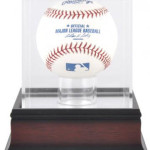
Once you have the ball, buying a display case is a small investment that will protect your ball as long as you own it. There are several different varities; square two-piece acrylic holders and round holders with a plastic or wooden base are two of the most popular. You can usually find them for under $10. Make sure it’s a U/V protective case-at least 50%. It also helps prevent the handling of the baseball by you or your visitors which can damage it. It’s also a good idea to avoid fluorescent lighting.
If your signatures have already faded or you have a very old baseball with faded signatures, never retrace them to make them stand out. Even a ball with fading signatures will be worth more than one that’s been traced.
It’s also a good idea to keep your hand-signed baseballs in a temperature-controlled environment. You don’t have to invest in an elaborate set-up; just keep it in a room where the temperature remains under 75 degrees most of the time, with lower humidity.
You can see some high quality, authenticated autographed baseballs on eBay
No Comments »
Over sixty years have passed since Babe Ruth signed his last autograph. A generation has grown up, worked and retired since the Babe died of cancer in 1947. His impact on American sports remains huge and the interest in Ruth memorabilia-like the Babe himself-is larger than life.
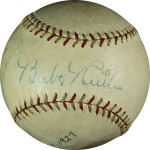
Babe Ruth autographed baseballs are still the most coveted by collectors and fans despite the fact that the Bambino likely signed hundreds of thousands of autographs over a 40 year-period. He was besieged everywhere he went and more often than not, he complied.
Ruth was really the first baseball player to be popular enough to have been afforded star treatment by those who wanted a lasting memory in the form of an autograph.
The highest price paid for a Ruth autographed ball was achieved in 2005 when one changed hands privately for $150,000, a tribute to the uncommonly high quality of the baseball and the signature. The ball was graded 9.5 by PSA/DNA
A PSA 8-graded Babe Ruth autographed baseball, preserved in the original box by a retired dentist who received it as a teenage ballplayer in the 1940s, established a new high for the grade when it sold for $81,075 in 2007.
If you’re lucky enough to own one, however, don’t expect to get that much for it, should you choose to sell. Likewise, don’t expect to have to pay that much for one if you’d like to add this ‘holy grail’ of baseball autographs to your collection. Most Ruth signed balls do show signs of age. A slightly faded signature, a ball that’s been treated with shellack or tossed around in the yard by some 1930s kid or one that contains other autographs is worth much less. The best Babe Ruth autographed ball to get is a single-signed version that’s been authenticated by one of the more reputable companies in the industry. You’ll pay a little more, but it’s worth the investment. And yes, Ruth signed balls can be considered an investment. They’re not going down in value anytime soon.
The best advice for anyone seeking out a Ruth autograph? Buy the best you can afford. It’ll give you more enjoyment and it will be easier to sell for a profit if you choose to do so at a later date.
Keep in mind there are a lot of authentic Ruth autographed baseballs floating around and patience combined with a discerning eye can be the key to owning a ball you’ll be proud to show off without having spent too much.
No Comments »
|